
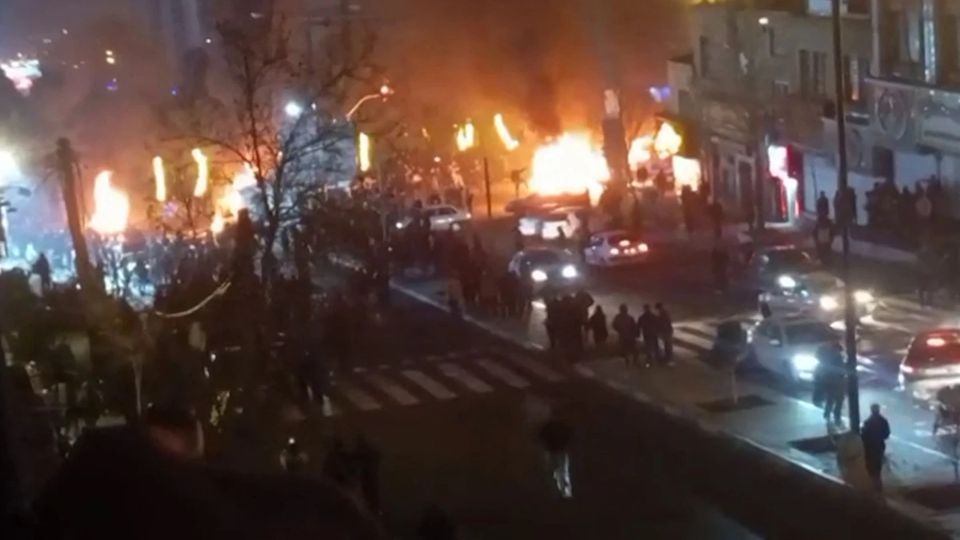
"Reza Pahlavi, son of the Shah, appeared in a video message from exile in the United States, calling on people to take to the streets to overthrow the regime. Groups of young people responded in an organized manner at 8 p.m. on Thursday, January 8, chanting, “This is the final battle, and Pahlavi will return.”
Reaching the heart of Tehran these days is no easy task. This is not necessarily due to the suspension of direct travel between Beirut and Tehran, nor to the disruption of flight schedules following a sudden airspace closure. The deeper issue is this: anyone visiting Tehran at the moment senses that it is a closed city. Tehran does not readily reveal itself to those who enter it. People speak sparingly, and the excess of “normalcy” only intensifies the sense that something is profoundly abnormal.
At the airport, sorrowful faces confront you; men and women holding photographs of their sons. A general enters the terminal briskly and confidently, followed by a cleric struggling to keep pace, cameras trailing behind them. They exchange hurried greetings with the crowd and move on, leaving the grieving faces behind. Asking about the scene, one learns that these are families of those martyred in the most recent war between Iran and Israel, returning from a religious and commemorative visit to Iraq.
On the road into Tehran, everything appears normal. The police, the shops, the reckless speed of taxi drivers, everything seems as it always has. At night, silence prevails. A silence so deep it is deafening.
By morning, the city’s rhythm resumes. People walk the streets as though nothing has happened. Aside from police officers and masked security forces stationed at intersections and junctions, a newcomer would hardly sense that anything extraordinary occurred days earlier. When asked about the calm, the response is that people in Tehran, contrary to expectations, vent their anger in the streets, then quickly return to their routines and to what they know. It is as though the streets have become a Brechtian stage; a space for catharsis, nothing more. Yet one is forced to remember that those killed days earlier in Tehran’s streets were flesh and blood. Blood does not lead to catharsis; it only compounds the suffocation.
The crisis in Tehran is not fleeting. It has multiple faces, depending on the observer. The story of Tehran’s streets has always been, at its core, the story of revolution. The difference this time is that the crisis is economic, political, and cultural, and its most difficult aspect is that it has become a bloody one.
The roots of Iran’s crisis go back to the early 1990s, when the state began post–Iran–Iraq war reconstruction policies. At the time, Rafsanjani founded the Executives of Construction Party. His hope was for it to resemble the Islamic Republic Party established by Beheshti after the victory of the Islamic Revolution.
Like Beheshti, Rafsanjani envisioned a party that would bring together state cadres and technocrats. In effect, this was akin to a vanguard party, a party that leads the state, but with more liberal and open policies than those pursued in socialist countries. The experiment was short-lived and soon faltered for many reasons. Nonetheless, throughout the 1990s, the Iranian government gradually pursued privatization policies.
The real estate bubble expanded steadily, and the cost of living rose sharply. Yet the state, aided by oil revenues, managed to contain much of the social fragmentation produced by these policies. Oil income provided sufficient returns and allowed the public sector to absorb new social strata. Throughout the 1990s, these strata formed the middle class. In other words, the public sector absorbed the middle class and wrapped it within the state.
As in Syria, Iraq, Libya, and elsewhere, indicators of middle-class expansion were deceptive. This class was not part of the market so much as it was part of the state bureaucracy. Politically, this meant that a large segment of society was neutralized and removed from the public sphere and from politics. These groups lacked political representation, yet enjoyed relative economic comfort. More precisely, they did not perceive themselves as concerned with political questions as much as with economic growth and improved living standards.
As in other countries, these policies led to the growth of central cities at the expense of the periphery. Tehran became the destination of state officials and the locus of power, while rural areas and the margins suffered increasing neglect. The election of Mohammad Khatami in 1997 crowned this phase and, in reality, marked the beginning of the death of politics, in its true sense, in Iran.
Contrary to how many in the Arab world view the Khatami era, the man had no substantive domestic project beyond a promise of openness to the world. To describe that moment of social liberalization, one must borrow from Serbian thinker Branko Milanović’s writings on the death of politics.
Politics came to be seen as a mere occupation. An individual’s standing and share within the system became tied to their vote. “If you want a stable life, elect me”—this was the foundation of Khatami’s discourse. He offered no concrete political program, only the promise of opening up to the world. And as the death of politics inevitably brings with it the rise of identity-based discourse, Ahmadinejad arrived with his populism. He, too, was little more than a mirror image of Khatami: the latter armed himself with unconditional openness to the West, while Ahmadinejad armed himself with rhetoric of rejecting it. Reality, however, remained unchanged.
In the 2009 crisis, successive governments adopted a policy of crisis management and nothing more. Western sanctions further worsened living conditions. According to many experts, US sanctions on Iran rank among the most severe in history, second only to Washington’s sanctions on Iraq after the Gulf War. Many expected the Iranian system to collapse quickly under such pressure, but Tehran has its own path and its own methods of confrontation.
To withstand sanctions, Tehran relied heavily on the shadow economy- at great cost. Economic parasites flourished on the margins of the bazaar. One insider recounts how a figure like Babak Zanjani rose, in less than a decade, from being a minister’s driver during the Khatami era to one of Iran’s most influential economic actors. He devised methods for exporting oil while evading sanctions, and over time became a financial empire rivaling the historic “400 families” that have long dominated Iran’s economy.
People say that when Zanjani’s activities threatened too many interests, he was imprisoned for ten years, only to emerge stronger than before. Today, he reportedly runs a network of land-transport companies inside and outside Iran. No one seems capable of restraining him. The sole losers in this economic quagmire are ordinary people and the middle class.
In Tehran, people have moved eastward in search of cheaper rents. The old north–south divide no longer defines social status. Neighborhoods such as Nazi Abad, in eastern Tehran, have become destinations for a middle class crushed by inflation. It was in this very neighborhood that protests erupted on the eve of January 8.
The current crisis, briefly
On the morning of Sunday, December 28, 2025, the first demonstrations began when shop owners in Aladdin Mall, in central Tehran, protested the rise of the dollar. The Iranian toman had lost a third of its value in the preceding month. That day passed without significant unrest. In the days that followed, protests continued as Tehran’s universities joined in.
For many, those three days were marked by a struggle between the university and the bazaar over who would lead the movement and how it should move forward. There was a shared sense that this crisis differed from those before it. President Masoud Pezeshkian responded by inviting trade unions to dialogue, meeting them quickly on December 30. Under renewed street pressure, meetings continued at a rapid pace. Just a week later, Pezeshkian and Judiciary Chief Gholamhossein Mohseni Ejei met with representatives of markets and unions, announcing a roadmap to resolve the crisis through new tax exemption laws and the formation of joint committees.
Once again, reality surprised everyone. This time, the spark did not come from within Tehran or its markets, but from a figure “outside history and geography.” Less than 24 hours after the Pezeshkian–Ejei meeting, Reza Pahlavi, son of the Shah, appeared in a video message from exile in the United States, calling on people to take to the streets to overthrow the regime. Once again, the irony was striking: groups of young people responded in an organized manner at 8 p.m. on Thursday, January 8, chanting, “This is the final battle, and Pahlavi will return.”
Within hours, Pirouzi Street in eastern Tehran and Nazi Abad in the south were filled with an estimated 9,000 protesters, according to local residents. Some demonstrators carried bladed weapons; others fired live ammunition at police, security forces, and ambulances. According to witnesses at the Behesht-e Zahra cemetery morgue the following morning, many of the dead had been shot in the neck at point-blank range. Security forces did not decisively confront the violence until Friday evening, when they moved with an iron fist.
The exact death toll remains unclear. No precise figures have been confirmed. Many blame the police and security forces for the chaos that night, while officials argue that no one anticipated such levels of violence. What is beyond doubt is that Tehran has reached a dangerous level of tension.
At the end of a long day walking through the city, one phrase lingers, repeated endlessly by its people whenever asked about Tehran and the situation:
“Tehran is alright, and yet…”