
November 7, 2025
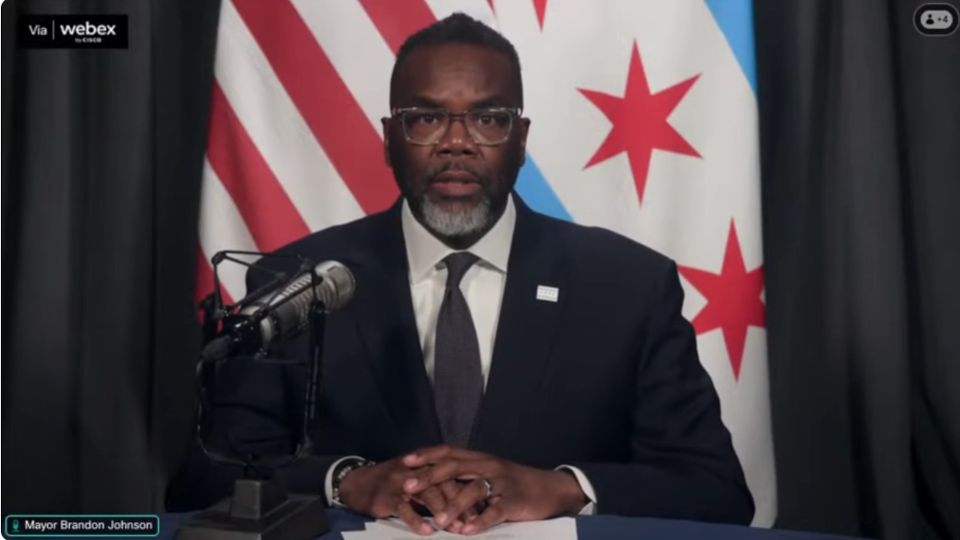
Mayor Brandon Johnson’s Prepared Remarks
Human Rights Council, Geneva
November 7, 2025 Mayor Brandon Johnson’s Prepared Remarks Human Rights Council, Geneva
Good morning, distinguished members of the Human Rights Council, representatives of United Nations agencies, esteemed diplomats, civil society leaders, and fellow public servants.
I am deeply honored to join you today in this historic gathering—a moment that brings together state and local officials from across the United States to speak with one voice in defense of human rights at home. I want to begin by expressing my gratitude to my co- panelists, to the local and state leaders who made this journey, and to the civil society organizations and activists whose persistence, advocacy, and courage have kept the pressure on the federal government to live up to its human rights commitments. Your work—often carried out under difficult conditions—is the conscience of this country. To our colleagues here at the United Nations—diplomats, human rights officers, and independent experts from the Office of the High Commissioner for Human Rights—I thank you for your steadfast attention to the troubling developments in the United States, and especially in Chicago. Many of you have already raised concerns about the deployment of the National Guard in U.S. cities, the militarization of law enforcement, the abusive immigration crackdowns, and other serious setbacks in the protection of fundamental rights. On behalf of the City of Chicago, I want to acknowledge your statements and expressions of concern. Your vigilance matters. It signals to our communities that the world is watching, and that international standards of dignity and justice apply to all nations— including my own.
We are here because the federal government, under the Trump administration, has failed to meet even the most basic expectations of transparency and accountability before this Council. By refusing to submit its Universal Periodic Review report and declining to appear for its review, this administration seeks to evade scrutiny for its violations of human rights—just as it has sought to evade accountability for its actions in cities like mine. This refusal to engage in good faith with international mechanisms for accountability and oversight is a moral failure.
In Chicago, we live with the consequences of that moral failure every day. Families torn apart by immigration raids. Raids that have targeted daycare teachers, ride-share drivers, and restaurant cooks. Honest, hardworking, law-abiding people who contribute to the soul of Chicago, who literally make our City run.
The federal government’s immigration enforcement has been marked by violence and an assault on the dignity of all Chicagoans. Federal agents drag parents out of their vehicles in the pickup line for elementary schools, they throw neighbors supporting their neighbors to the ground and assault them. Right before Halloween, federal agents deployed tear gas on a children’s neighborhood parade. This harm is not just concentrated on our immigrant communities.
In Chicago’s South Shore neighborhood—a proud, predominantly Black community— federal agents carried out what can only be described as a military-style raid designed for social media spectacle. Helicopters circled overhead. Doors were kicked in. Homes were destroyed. Immigrant residents were detained in one van, while Black families—including young children—were held in another.
On the West Side, federal agents placed a Black Chicagoan in a chokehold and forced him to the ground—just steps from the doors of the Westside Center for Justice, a space meant to protect and uplift our people.
Earlier this week, federal agents crashed into the vehicle of Dayanne Figueroa – a US citizen who was on her way to get coffee before heading to work. The agents then took her into custody for no apparent reason.
These are not isolated incidents. They are reminders that the fate of our communities— Black, Brown, immigrant—is bound together. An attack on one of us is an attack on all of us. And in Chicago, we will stand united in defense of our shared dignity, safety, and freedom. The harms emanating from the federal government are not only rooted in immigration enforcement.
Black and brown communities contend with deepening cycles of poverty while federal programs that once sustained them are gutted. One in five households in the City of Chicago receives federal assistance to address food insecurity. As a result of the federal government’s budget cuts and shutdown, these families will be left without this vital assistance.
As someone with first-hand experience, I can tell you how humiliating it is when you open the refrigerator and you have nothing to eat. In the wealthiest country in the world, there is no reason why our federal government should allow hundreds of thousands of Chicagoans to go hungry.
Because our administration has invested in addressing the root causes of harm and violence, Chicago has achieved historic reductions in crime and violence. The Trump administration’s budget cuts now threaten that progress—not just here in Chicago, but in cities across the country—by stripping resources from underserved communities. We have been clear: if the President truly cared about reducing violence in Chicago, he would restore the $800 million his administration cut from violence-reduction efforts and reverse the devastating cuts to life-sustaining public benefits. These are not abstract policy issues; they are the lived reality of our neighbors, and they are human rights violations.
But I also come before you to share the work that is happening in resistance to these injustices. In Chicago, we are taking concrete steps—through executive orders, local policy reforms, and community organizing—to ensure that our city protects our people. We have reaffirmed Chicago as a welcoming city. We have directed departments to refuse cooperation with civil immigration enforcement. We are developing community-based alternatives to policing, expanding access to mental health care, investing in treatment rather than trauma, and working alongside state partners to guarantee that no one loses access to basic needs like utilities or housing because of federal indifference. In Chicago, we believe that every resident—regardless of immigration status—deserves safety, dignity, and protection under the law. Our Rapid Response Immigration Teams are a key part of how we make that belief real.
These teams are led by trusted community organizations who mobilize when there are reports of immigration enforcement activity. They work around the clock to verify information, prevent the spread of misinformation, and ensure that families know their rights.
Rapid Response Teams also serve as a bridge between the City and community networks— ensuring that alerts, “Know Your Rights” materials, and hotline information reach residents quickly and accurately. They connect directly with faith leaders, mutual aid groups, and neighborhood advocates so that no one is left isolated or uninformed in a moment of fear. This is what it means for Chicago to live its values as a sanctuary city—not just in words, but through coordinated action that protects our neighbors, strengthens community trust, and reaffirms that every person belongs here. And across our city, community violence interruption programs are proving every day that safety grows from relationships. These are credible messengers—people who know our neighborhoods, who have lived through the same struggles—working to prevent conflict before it starts. They mediate disputes, connect individuals to services, and offer pathways out of harm’s way.
Together, these efforts form the foundation of a new kind of safety infrastructure—one built on dignity, accountability, and love for our city and its people. We cannot do this alone. That is why I call on this Council to hold the federal government of the United States to the same standards of accountability you apply elsewhere in the world. No country should be above international law. Human rights are universal—or they are meaningless.
Chicago has long been part of this struggle. From the 1950s, when the Civil Rights Congress brought the We Charge Genocide petition to this very body, to the young organizers who marched here decades later demanding an end to police violence, to the courageous lawyers and survivors of the Chicago Police Department’s torture scandal who compelled the UN Committee Against Torture to call for justice and reparations—our city’s residents have long insisted that global human rights norms must be realized locally. We stand in that proud tradition today
As I close, I invite the UN’s independent experts to visit Chicago—to witness both our challenges and our progress firsthand. And I urge the Human Rights Council to consider additional measures of accountability, including a special session to examine the worsening human rights crisis in the United States. The people of Chicago—and of this nation— deserve a government that honors their dignity, not one that diminishes it. Thank you for your time, your attention, and your continued solidarity in the global fight for human rights.